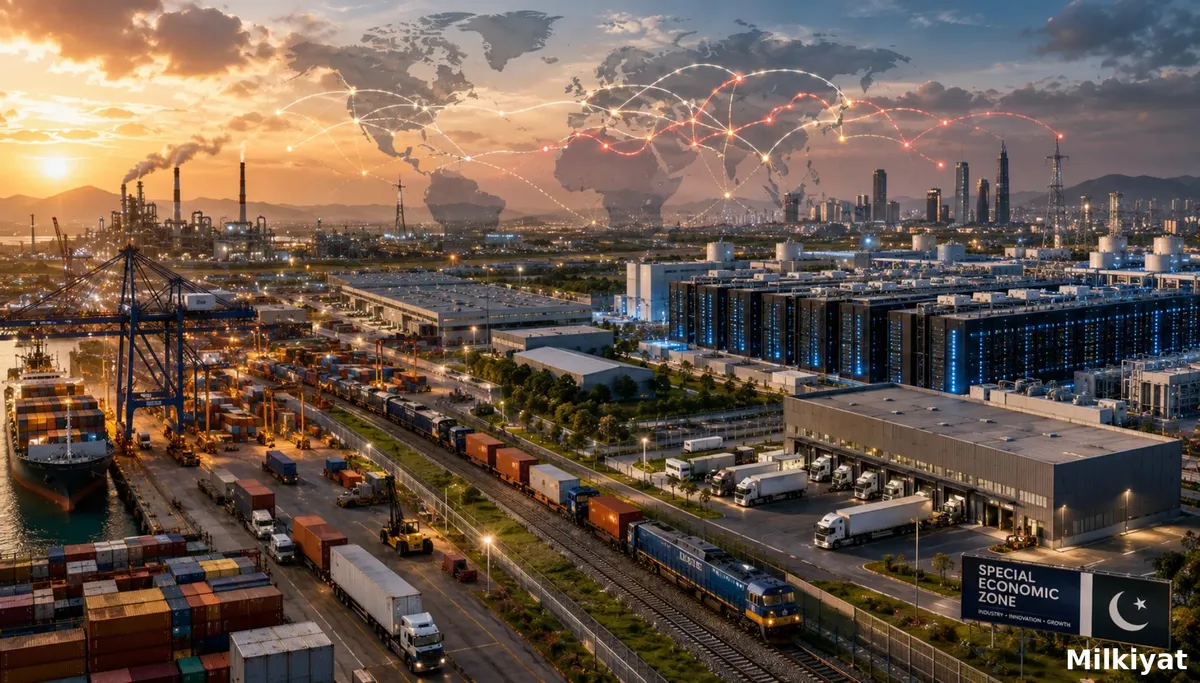
Pakistan, strategically located at the crossroads of South Asia, Central Asia, and the Middle East, stands to become a significant, albeit largely untapped, beneficiary of the deglobalisation trend. The country's potential lies in its burgeoning network of Special Economic Zones (SEZs), its role in regional connectivity projects like the China-Pakistan Economic Corridor (CPEC), and its growing digital economy, which necessitates robust data center infrastructure.
The expansion of SEZs is a critical component of Pakistan's strategy to attract foreign investment and boost industrialization. The number of SEZs in Pakistan has grown substantially, from just seven in 2019 to 44 by 2025, with a focus on providing incentives and infrastructure for manufacturing and export-oriented industries [13]. These zones are ideal locations for companies looking to nearshore or friend-shore their operations, offering tax breaks, streamlined regulations, and access to a large labor pool. The CPEC, while facing its own challenges, continues to develop logistics corridors and industrial parks that can facilitate regional trade and manufacturing, further enhancing Pakistan's appeal as a logistics and industrial hub.
Furthermore, Pakistan's rapidly expanding digital landscape is creating a significant demand for data centers. As local businesses embrace digitalization and international companies seek localized data storage solutions, the country's data center potential is growing. Investment in this sector, coupled with improvements in fiber optic connectivity and energy infrastructure, could position Pakistan as a regional data hub. For real estate investors, this translates into opportunities in developing and managing industrial parks, logistics warehouses, and state-of-the-art data centers within these SEZs and strategic corridors. The key to unlocking this potential lies in continued policy stability, infrastructure development, and a concerted effort to attract and facilitate foreign direct investment [14].
Investment Outlook (2026–2030)
The period between 2026 and 2030 is poised to be a transformative era for global real estate, shaped predominantly by the enduring forces of deglobalisation and technological advancement. Investors will increasingly prioritize resilience, strategic importance, and long-term value over short-term gains, leading to a reallocation of capital across sectors and geographies.
Institutional Investors: Large institutional investors, including pension funds and sovereign wealth funds, will continue to increase their allocations to alternative real estate assets such as data centers, logistics facilities, and specialized industrial properties. Their focus will be on assets that offer stable, inflation-hedged income streams and are critical to the functioning of the new, more localized global economy. Platforms that can aggregate and manage these specialized assets across multiple regions will be particularly attractive.
Developers: Developers will need to adapt to changing demand patterns, focusing on building flexible, sustainable, and technologically advanced facilities. This includes developing smart warehouses with automation capabilities, energy-efficient data centers, and industrial parks designed for specific manufacturing needs (e.g., advanced robotics, clean energy integration). The ability to navigate complex regulatory environments and secure reliable power and connectivity will be crucial.
REITs (Real Estate Investment Trusts): REITs specializing in industrial, logistics, and data center properties are expected to outperform. Their diversified portfolios of income-generating assets in these high-demand sectors will appeal to investors seeking exposure to the deglobalisation trend. However, REITs with heavy exposure to traditional office and retail, particularly in secondary locations, may face headwinds.
Governments: Governments will play a pivotal role in shaping the real estate investment landscape through policy incentives, infrastructure spending, and regulatory frameworks. Those that actively promote friend-shoring, nearshoring, and digital infrastructure development through favorable tax regimes, SEZs, and efficient permitting processes will attract the most capital. Investment in critical infrastructure, such as reliable energy grids and high-speed internet, will be essential to support these new real estate demands.
Risks: Navigating the New Landscape
While deglobalisation presents significant opportunities, it also introduces a new set of risks that real estate investors and developers must carefully navigate. The shift away from a globally optimized system creates inherent inefficiencies and potential for increased costs.
Inflation and Interest Rates: The reshoring and nearshoring of manufacturing can lead to higher production costs due to increased labor expenses and stricter environmental regulations in developed economies. These higher costs can contribute to inflationary pressures, which, in turn, may prompt central banks to maintain higher interest rates. Elevated interest rates increase borrowing costs for real estate development and acquisition, potentially dampening investment activity and impacting asset valuations. The cost of capital becomes a more significant factor in project feasibility.
Regulatory Tightening and Trade Barriers: Deglobalisation is often accompanied by increased protectionism, including new tariffs, import quotas, and non-tariff barriers. These measures can disrupt supply chains, increase the cost of materials for construction, and complicate cross-border real estate transactions. Furthermore, a patchwork of evolving national regulations, particularly concerning data sovereignty and environmental standards, can create compliance challenges and add to operational complexities for multinational real estate portfolios.
Energy Costs: The operation of modern industrial facilities and, especially, data centers is highly energy-intensive. As geopolitical tensions impact global energy markets and the transition to renewable energy sources progresses, energy costs can be volatile. Data centers, in particular, require massive and reliable power supplies, making them vulnerable to energy price spikes and grid instability. Investment in on-site renewable energy generation and energy-efficient designs will become increasingly critical to mitigate this risk.
Geopolitical Volatility: While deglobalisation is partly a response to geopolitical risks, the process itself can be destabilizing. Ongoing conflicts, trade disputes, and political instability in key regions can deter foreign investment, disrupt construction projects, and impact property values. Investors must conduct thorough geopolitical risk assessments for each market, considering factors beyond traditional economic indicators. The focus on "friend-shoring" also implies a greater sensitivity to political alliances and potential shifts in international relations.
Successfully navigating these risks will require a nuanced understanding of global economic and political dynamics, a flexible investment strategy, and a strong emphasis on due diligence and risk mitigation in real estate development and acquisition.
Related Reading on Milkiyat
FAQ
Q1: What is deglobalisation and how does it impact real estate?
A1: Deglobalisation refers to the trend of decreasing interdependence and integration among national economies, driven by factors like geopolitical tensions and supply chain vulnerabilities. It impacts real estate by shifting demand towards more localized, resilient assets such as data centers, logistics hubs, and industrial facilities that support nearshoring and friend-shoring strategies.
Q2: Which real estate sectors are benefiting most from deglobalisation?
A2: Data centers, logistics and industrial real estate are the primary beneficiaries. Data centers are crucial for digital infrastructure, while logistics and industrial properties support the relocation of manufacturing and storage closer to end markets or allied nations.
Q3: How is PwC's 2026 Global Outlook addressing deglobalisation?
A3: PwC's 2026 Global Outlook reports highlight deglobalisation as a top concern for real estate professionals. They emphasize the industry's adjustment to a prolonged period of transition, with a focus on resilient assets and long-term value in a volatile environment.
Q4: What role do geopolitical tensions play in this trend?
A4: Geopolitical tensions, such as the US-China rivalry and regional conflicts, accelerate deglobalisation by forcing nations and corporations to prioritize supply chain security and national interests over pure economic efficiency. This leads to strategic realignments like friend-shoring and nearshoring, driving demand for new real estate infrastructure.
Q5: How can Pakistan benefit from deglobalisation in real estate?
A5: Pakistan can benefit through the expansion of its Special Economic Zones (SEZs), the development of logistics corridors under CPEC, and its growing potential as a data center hub. These factors can attract foreign investment in industrial and digital infrastructure, supporting localized manufacturing and data storage needs.
Conclusion
The forces of deglobalisation are fundamentally reshaping the global economic order, and with it, the landscape of real estate investment. The PwC 2026 Global Outlook provides a clear lens through which to view this transformation, underscoring the critical importance of resilience, strategic location, and specialized asset classes. As supply chains reconfigure, digital infrastructure expands, and geopolitical considerations drive investment decisions, sectors such as data centers, logistics, and industrial real estate are poised for sustained growth. While challenges like inflation, regulatory shifts, and energy costs persist, the overarching trend points towards a more localized, secure, and technologically advanced real estate ecosystem. For astute investors and developers, understanding and adapting to these shifts will be paramount to unlocking significant opportunities in the years to come, particularly in emerging markets like Pakistan that are strategically positioned to capitalize on this new global paradigm.
References
[1] PwC. (2025, November 4). Emerging Trends in Real Estate®: Europe 2026. Retrieved from https://www.pwc.com/gx/en/industries/financial-services/real-estate/emerging-trends-real-estate/europe.html
[2] PwC. Emerging Trends in Real Estate® 2026. Retrieved from https://www.pwc.com/us/en/industries/financial-services/asset-wealth-management/real-estate/emerging-trends-in-real-estate-pwc-uli.html
[3] PERENews. (2025, February 6). Drive for resilience recalibrates global logistics. Retrieved from https://www.perenews.com/drive-for-resilience-recalibrates-global-logistics/
[4] JLL. (2026, January 5). 2026 Market Outlook for Global Data Centers. Retrieved from https://www.jll.com/en-us/insights/market-outlook/data-center-outlook
[5] Precedence Research. Data Center Market Size, Share, and Trends 2026 to 2035. Retrieved from https://www.precedenceresearch.com/data-center-market
[6] Arizton. GCC Data Center Market – Industry Outlook & Forecast 2026-2031. Retrieved from https://www.arizton.com/market-reports/gcc-data-center-market-analysis
[7] Research and Markets. Data Center Real Estate Global Market Report 2026. Retrieved from https://www.researchandmarkets.com/reports/6226021/data-center-real-estate-global-market-report?srsltid=AfmBOoqpK6fnCYyMlwDJ5QaYsLaMf1jcurBTauVMuhFLqgVBvSCxwFgz
[8] JLL. (2025, December 8). Global Real Estate Outlook. Retrieved from https://www.jll.com/en-us/insights/market-outlook/global-real-estate
[9] Cushman & Wakefield. Nearshoring: Opportunities for Real Estate in EMEA. Retrieved from https://www.cushmanwakefield.com/en/united-kingdom/insights/nearshoring-opportunities-for-businesses
[10] JLL. (2024, January 4). . Retrieved from
[11] Clarion Partners. (2025, December 11). . Retrieved from
[12] World Bank. (2026, April 8). . Retrieved from
[13] Profit by Pakistan Today. (2026, January 16). . Retrieved from
[14] PIDE. . Retrieved from